Stovepipe Academy School History 1870s–1914
The story of Aldie's first public school
Education in Reconstruction-Era Virginia
Before the Civil War, Virginia had no statewide system of free public schools. Formal education was mostly for well-to-do families, often through tutors or private academies.
Virginia established its first statewide system of free public schools in 1870, following the ratification of the new state constitution—one of the most important accomplishments of Reconstruction (the Reconstruction era: 1865–1877).
William H. Ruffner, Virginia's first Superintendent of Public Instruction, oversaw the creation of the school system. It was a monumental task: building schools, training teachers, establishing curriculum, and convincing communities to support public education.
Schools in this era were largely the responsibility of local parents and communities. They found or built their schoolhouses, sometimes suggested teachers, and often provided labor for repairs.
The Stovepipe Academy belongs to this first generation of public schoolhouses—built by and for the community of Aldie in the earliest years of free public education in Virginia. It is a physical reminder of a pivotal moment in the state's schools history.
A Revolutionary Change
The establishment of Virginia's public school system in 1870 was one of the most important accomplishments of Reconstruction. For the first time, all children in the state—regardless of economic status—had access to free education. It was a revolutionary change, and buildings like the Stovepipe Academy were where that promise was made real.
A School Born from Reconstruction
The Aldie Stovepipe Academy was built in the early 1870s—possibly as early as 1872—as part of the era's new wave of public education. It was designated School #10 in the Mercer School District, named for the village of Aldie founder Charles Fenton Mercer.
Funds for construction were raised through horse meets and steeplechases held on the adjacent field, the grounds of the current Aldie Elementary School. This community-driven fundraising reflects the grassroots nature of public education in this era.
What the Building Tells Us
To study the Stovepipe Academy is to understand how Aldie's children experienced education in the earliest years of Virginia's public school system.
The building's modest scale, simple materials, and functional design reflect both the limited resources available to rural communities and the determination of those communities to provide education for their children.
School Life
The school operated from the early 1870s to 1914—over four decades of service to the families of Aldie village and the surrounding countryside.
School terms were short, attendance was not compulsory, and teacher salaries were low—reflecting the limited resources and rural character of public education in this period.
Transportation
Students mostly walked to school or came on horseback as John Gulick's grandfather did. According to an oral history recorded with the Edwin Washington Project, Alan Gulick's horse would find its own way back home along Tail Race Road after delivering Alan each schoolday morning.
A Two-Room Schoolhouse
Significantly, Stovepipe Academy originated as a two-room schoolhouse justified by Aldie's rising school-age population. The student scholars were most likely organized between the two classrooms by elementary and secondary school cohorts.
Main Entry Cloakroom
Stovepipe's main entry was on the east wall directly into the schoolhouse cloakroom, where students would have hung or stowed their outerwear and belongings. The cloakroom's original blue color has been preserved; the same cloakroom color was found in the 1920s Rosenwald Schools, thought to relate to the southern tradition of painting threshold spaces blue.
From the cloakroom, two doorways led to the North Classroom and to the South Classroom.
Classroom Furnishings
The two large classrooms would have been furnished with wooden tables and benches or chairs for the student scholars. These may have been upgraded over time with individual or double student desks. The students would have written on slates or scraps of paper.
Original Blackboards
The renovation uncovered original large wall-mounted blackboards—literally black-painted oak boards, the paint following a contemporary recipe based on burnt potato peelings. The surviving blackboards wrapped around the North Classroom's north end and lined the South Classroom's west wall. The South Classroom's original blackboards probably continued wrapping around its south end but did not survive by the time of the 2023–24 renovation.
The students would have learned lessons such as writing in cursive script and agricultural math problems still visible on the preserved blackboards, along with several skillful doodles.
The surviving original blackboards were covered over at the time of the schoolhouse's early 1900s remodel and were likely replaced with more modern slate chalkboards at that time. No evidence of more modern chalkboards survived by the time of the 2023–24 renovation.
Classroom Lighting
The North and South Classrooms originally had dark, unpainted beadboard paneling but large windows to admit natural daylight. The students would have studied by window light, supplemented by candle and lantern light. It is unlikely that Stovepipe Academy would have been electrified before its closing in 1914.
Cooling and Heating
Stovepipe Academy's classrooms had 12-foot ceilings and large double-hung windows for airflow during warm temperatures. Both were norms for schoolhouse construction of the era.
During the cold-weather months, Stovepipe Academy was heated by at least one wood-burning stove located in the North Classroom. In addition to the vertical stovepipe which vented through the roof, an interior system of pipes would have provided radiant heat. The renovation preserved evidence of the original vertical stovepipe.
The large South Classroom was probably heated by a second wood-burning stove, however no evidence remained by the renovation of 2023–2024 to tell for certain.
In the cold months, it was common custom for children to come to school with a piece of firewood contributed by their families to help fuel the wood-burning stove.
No Plumbing
The schoolhouse would have provided an outdoor outhouse whose location is unknown.
The renovation uncovered the remains of an underground cistern inside the North Classroom's east wall. The cistern would have stored rainfall runoff water as the school's water supply and storage system.
Schools relied on cisterns for:
- Drinking water (with caution), typically accessed via a bucket with a communal dipper or a rudimentary pitcher pump;
- Washing hands and faces before lessons or meals, or after recess;
- Wiping down blackboards, slates and desks, or cleaning inkwells and mopping floors;
- Fire fighting — notably the cistern was located close by the North Classroom's wood-burning stove.
The technology was straightforward: gutters along the roof captured rain, channelling the runoff into a filtration box or directly into a large storage tank. The water was then accessed by a hand pump or drawn up manually in buckets.
Rural schools were dependent on seasonal rainfall or snow melt for their water supply. A dry season could render the cistern empty, forcing schools to close temporarily or rely on students and teachers to haul water from another source — in Stovepipe Academy's case, this would have been the nearby mill race.
When the cistern ceased functioning as water storage, it may have been used as a coal bin when the schoolhouse's wood-burning system is thought to have been replaced by coal-burning stoves with masonry chimneys when the East Wing was added.
A Living Connection to the Past
To stand in the Stovepipe Academy today is to stand where children stood over 150 years ago—learning to read, to write, to calculate, in rooms warmed by a wood-burning stove.
Names and Faces
These data from surviving school records are thanks to research provided by the Edwin Washington Society/Project.
The school was visited once by the Superintendent during the 1895–96 year but is not known to have received any visits from District Trustees.
For the 1895–96 academic year, 12 boys and 26 girls were enrolled, including two students from the neighboring Broad Run District: Lelia and May Carruthers. Students' family names from this year include Carter, Furr, Matthews, Pearson, Gulick, Palmer, and Simpson—many of them farming families rooted in the Aldie community.
Known teachers included Miss Katie A. Russell (1895–96), Miss Hazel Gulick, Miss Elisabeth Furr, Mr. F.V. Pultz (who held a college-level certificate), and Miss Nettie Goode.
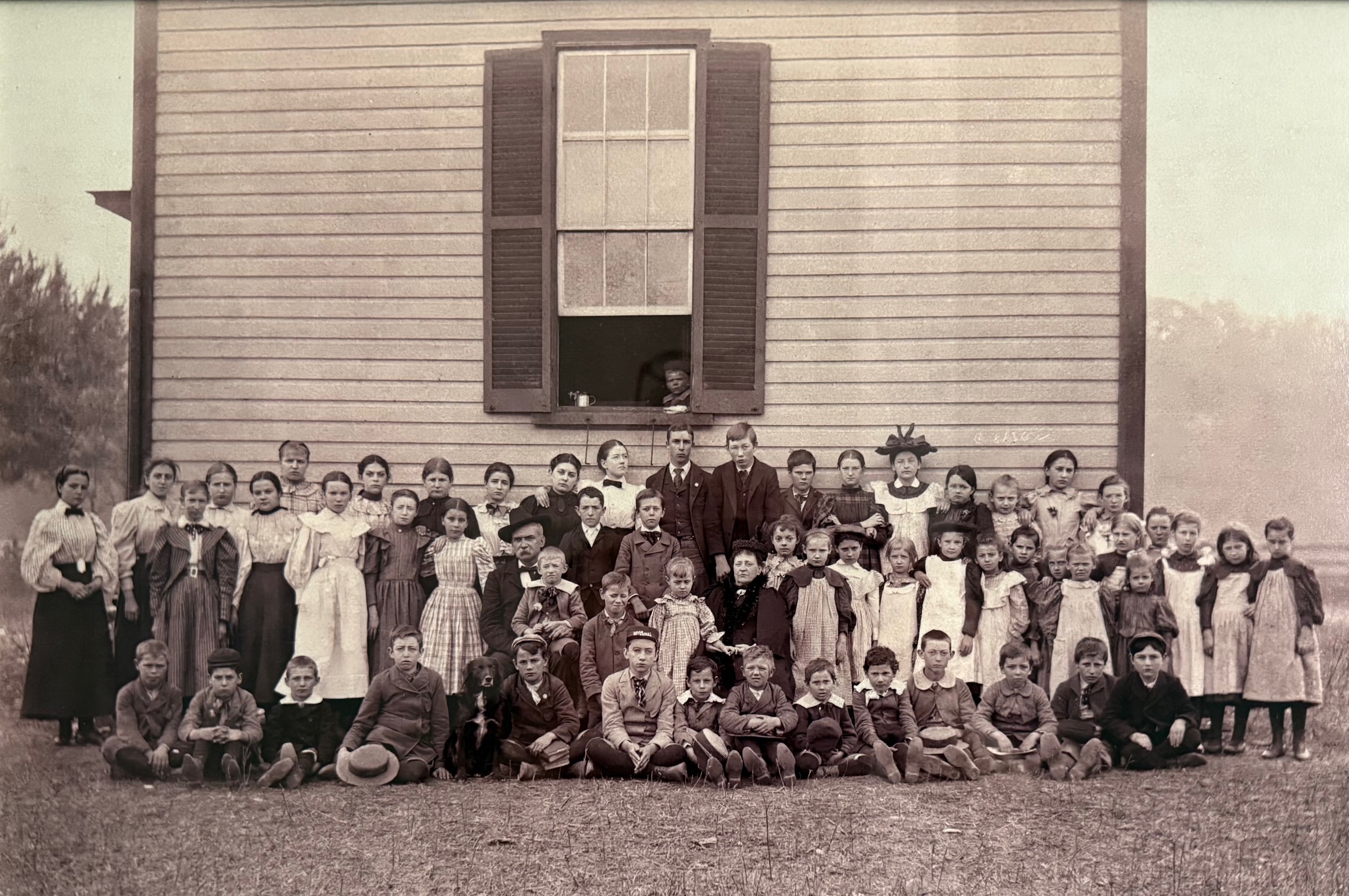
Students of the 1895–96 Academic Year
The following students attended:
Boys
- Edward, Willie and Ira Carter
- Claude, Harry, Otto and Irving Furr
- Charlie Matthews
- Lawrence Pearson
- Sherman Redman
- Johnson Russell
- Wallis Simpson
Girls
- Lelia and May Carruthers
- Lizzie (undecipherable)
- Florence, Lelie, Mary and Virgie Furr
- Allie and Ella Fry
- Myrtle and Pauline Gulick
- Bessie Hause
- Permelia and Edna Ish
- Maggie, Belle, Eva and Mary James Matthews
- Rachel and Mabel Palmer
- Jennie Pearson
- Elle and Ethel Redman
- Emily Simpson
- Sadie Smith
- Jamie Whitlock
A dignified roster of the children who once learned here, their names recorded in hand writing for Virginia schools history.
Older Students c. 1910s
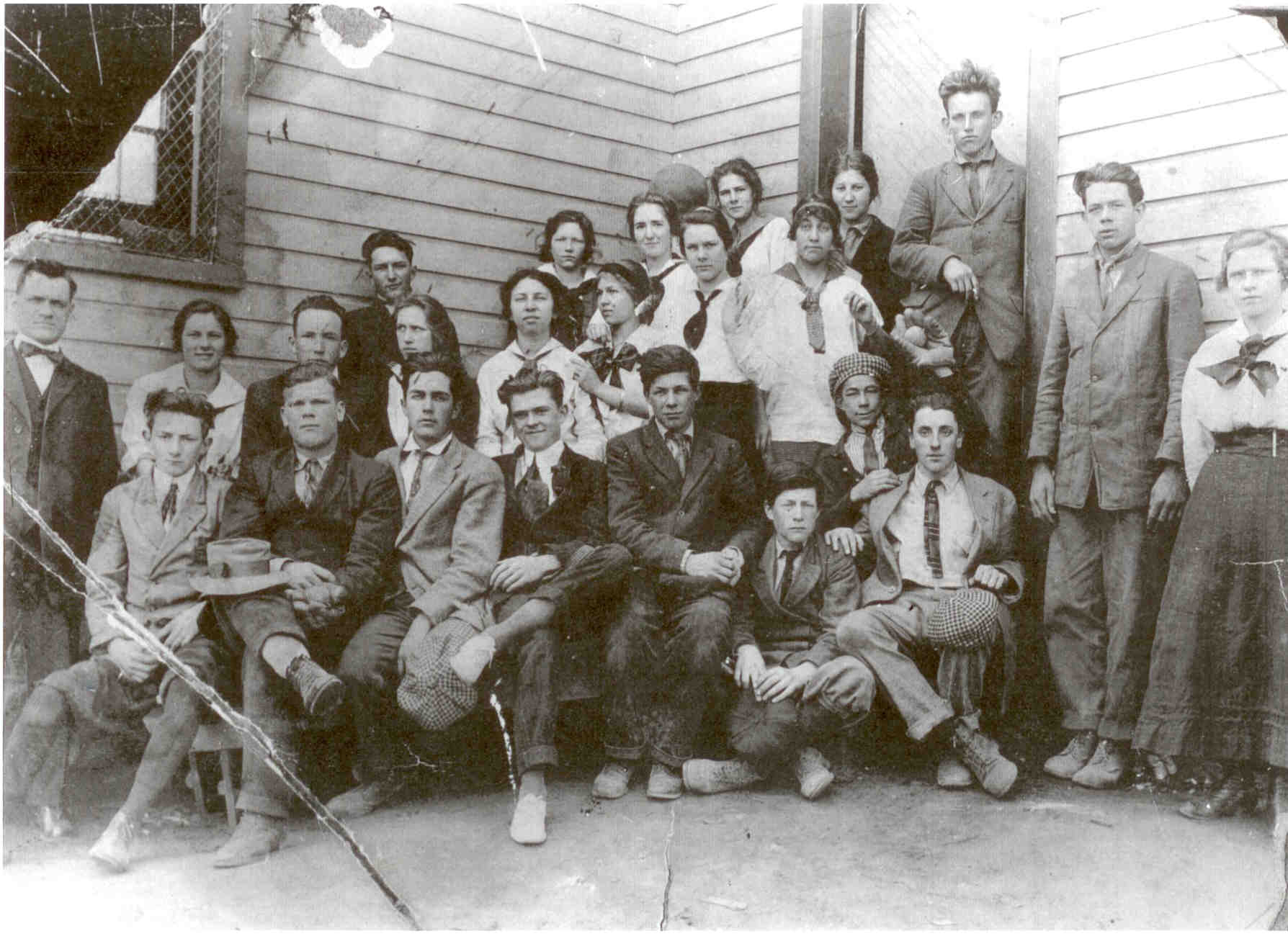
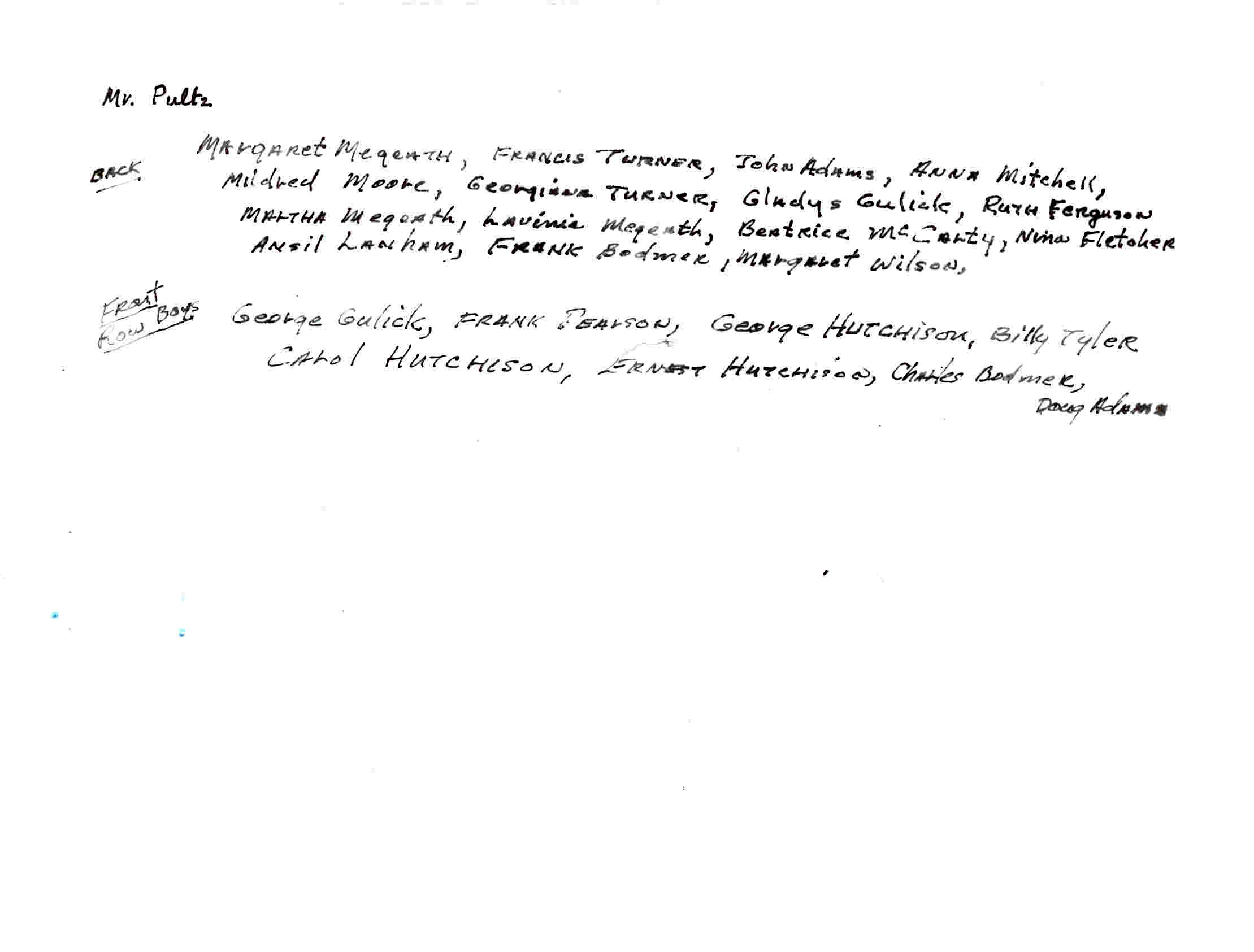
This photograph surfaced in an Aldie villager's digital files, undated and source of the original unknown.
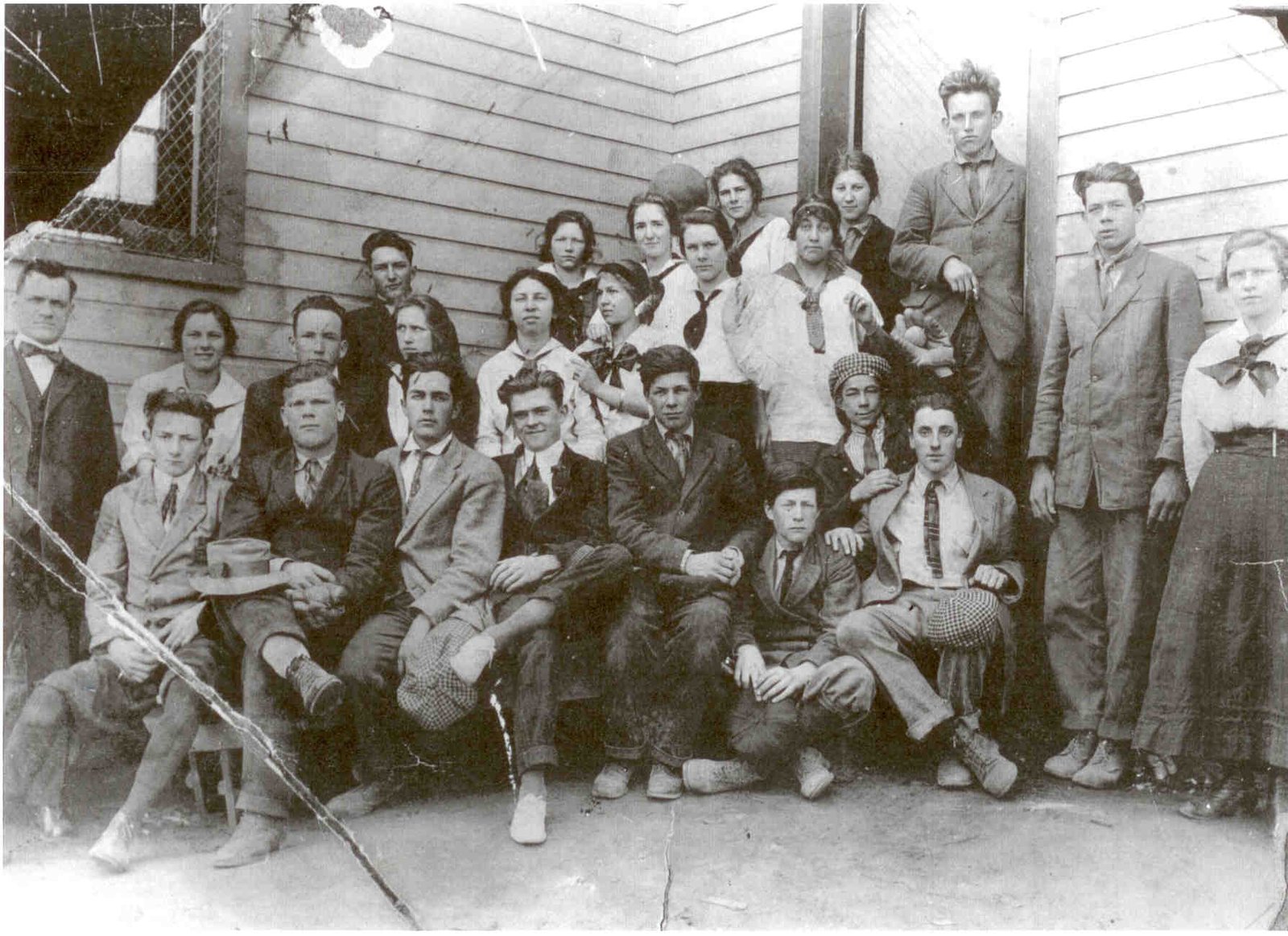
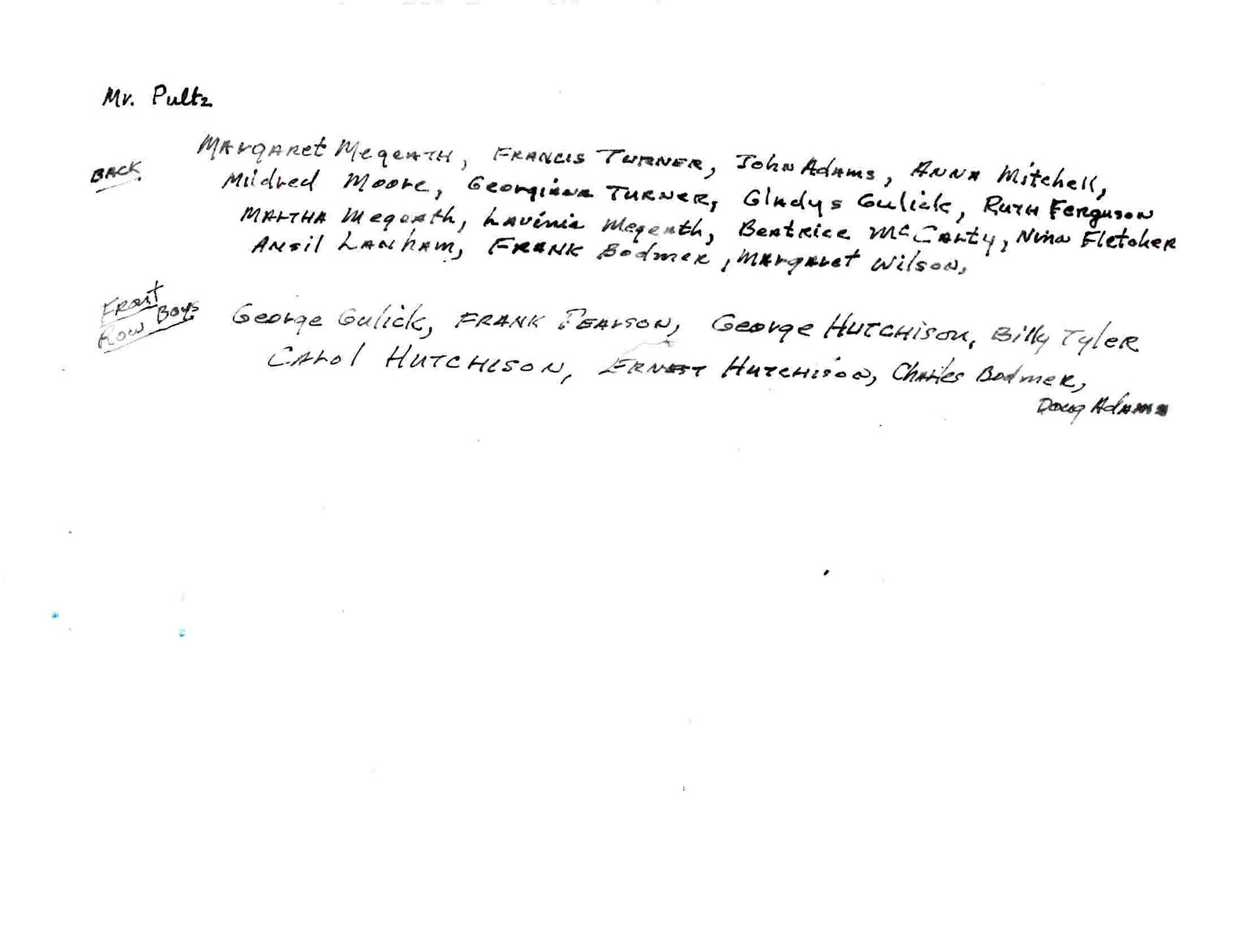
Back row: Margaret Megeath, Francis Turner, John Adams, Anna Mitchell, Mildred Moore, Georgiane Turner, Gladys Gulick, Ruth Ferguson, Martha Megeath, Lavinia Megeath, Beatrice McCarty, Nina Fletcher, Ansil Lanham, Frank Bodmer, Margaret Wilson.
Front Row Boys: George Gulick, Frank Pearson, George Hutchison, Billy Tyler, Carol Hutchison, Ernest Hutchison, Charles Bodmer, Doug Adams
A Timeline of Virginia Public Education
With Aldie Stovepipe Academy Highlights — Hover over each entry for details
Before 1865
No statewide public school system exists in Virginia.
- Formal education is mostly a privilege of the wealthy.
- In Aldie, informal schooling exists by 1858, with about 75 students attending a local village school, likely in a church or private home.
- Enslaved people are legally barred from learning to read or write.
1865–1870
Post-Civil War education reform begins.
- After the Civil War, education gains are made for all children regardless of economic status.
1869
The Virginia Constitution mandates public education.
- The Virginia Constitution of 1869, written during Reconstruction with input from African American delegates, mandates the creation of a public school system "for the education of all children of the State."
- This is the legal birth of Virginia public education.
1870
Virginia's public school system formally begins.
- William H. Ruffner is appointed the first Superintendent of Public Instruction.
- Virginia's public school system formally begins operation.
- Loudoun County establishes over 50 schools, including separate schools for white and Black students.
Early 1870s
The Stovepipe Academy is built in Aldie.
- The Stovepipe Academy is constructed on Meetinghouse Lane, likely between 1870–1872, funded through proceeds from local horse meets and steeplechases.
- The building features multiple stovepipes venting through its roof, inspiring its nickname.
- It becomes School #10 in the Mercer School District, serving white children in grades 1–7.
1895–96
38 students enrolled at Stovepipe Academy.
- Surviving school records show 38 students enrolled: 12 boys and 26 girls.
- Miss Katie A. Russell is the named teacher that year.
- Daily life includes walking long distances to school, learning the "three Rs," and heating the classrooms with a central stove.
1914
The Stovepipe Academy closes after 40+ years.
- The Stovepipe Academy closes after more than 40 years of service.
- It is replaced by the new Aldie High School and Elementary School nearby at 32369 Meetinghouse Lane, in a new purpose-built single large white frame structure reflecting Virginia's move toward consolidated education.
School Artifacts